Go Back
Field Analysis on Sustainable Agriculture by Alarko Holding and SKD Türkiye
“Strengthening Women’s and Youth Employment in Agriculture” Report Published
The Sustainability in Agriculture Task Force, operating under the Business Council for Sustainable Development Türkiye (SKD Türkiye) and led by Alarko Holding, has published a significant report titled “Strengthening Women’s and Youth Employment in Agriculture.”
Through its situation analysis and recommendations, the report aims to increase the participation of women and young people in the agricultural ecosystem. Based on a comprehensive field study conducted under the leadership of SKD Türkiye and Alarko Holding, with the participation of agricultural stakeholders from different regions and the contributions of Ülker, İş Bankası, İmece Mobil and the Alarko Agriculture Group, the report serves as an important reference for actions that will advance sustainability, equal opportunity and inclusiveness in the sector.
Continuing its sustainability-focused investments in modern greenhouse farming, niche fertilizers, climate-resilient seeds and dried food production, Alarko Holding also stands out with its multidimensional support for the development of women’s employment in agriculture. Positioning women and young people as key drivers of the transition toward innovative agricultural practices and a low-carbon, inclusive production model, Alarko also leads SKD Türkiye’s Sustainability in Agriculture Task Force as a member of the Association’s Board of Directors, sharing a common vision with SKD Türkiye.
Prepared under the leadership of SKD Türkiye and Alarko Holding, the “Strengthening Women’s and Youth Employment in Agriculture” report is based on a comprehensive field study involving nearly 400 sector stakeholders working in agricultural production areas across the Aegean, Central Anatolia and Black Sea regions. Aiming to strengthen equal opportunity, encourage inclusive employment models and contribute to making the future of agricultural production more resilient, efficient and innovative, the report places the role of women and youth at the center of agricultural transformation.
The analyses, based on a multidimensional dataset ranging from participants’ demographic characteristics and sectoral experience to their perceptions of technology, innovation and sustainability, as well as challenges related to occupational safety, climate change and employment barriers, also provide valuable insights into regional dynamics.
The findings of the report will also form the basis for field-based training programs to be implemented with the support of Alarko and other SKD Türkiye members participating in the Sustainability in Agriculture Task Force.
Key Findings of the “Strengthening Women’s and Youth Employment in Agriculture” Report
• According to data from the Turkish Statistical Institute (TURKSTAT), approximately 5 million people are employed in agriculture in Türkiye. However, over the past decade, the sector’s share of total employment has declined from around 20% to below 15%, revealing a serious risk in access to a qualified workforce.
• The number of women working in agriculture is approximately 2.3 million, accounting for nearly half of total agricultural employment. However, most women are employed informally, without social security, and as unpaid family workers. This situation renders women’s labor invisible and demonstrates that rural development is unsustainable without social protection.
• Education level is another major barrier: 85% of female participants are primary school graduates, a critical factor limiting women’s employment in agriculture.
• 64% of young participants show strong interest in entrepreneurship training, indicating that they can play a role not only as labor contributors but also as future entrepreneurs in agriculture.
• 58% of participants contributing to the report are under the age of 40, signaling that young people remain open to engaging in the agricultural sector and that, with appropriate support mechanisms, the future of agriculture can be transferred to younger generations.
• Significant knowledge gaps were identified in areas such as modern agricultural practices, good agricultural practices, soilless farming, agricultural development, pest control and proper fertilizer use. For example, 52% of participants stated that they have “no opinion” regarding seed breeding. This finding highlights insufficient access to information and agricultural education, underscoring the need for widespread, accessible and hands-on training programs, particularly for women and youth.
• While 47% of participants have less than three years of experience in agriculture and 30% have ten years or more, only 25% consider professional development opportunities to be sufficient. This indicates that the development needs of both newcomers and experienced workers are not being adequately met.
• The three most demanded training topics are:
- Sustainable agriculture practices
- Entrepreneurship and business development
- Fertilizer use and crop development
These preferences reflect strong expectations that agriculture should no longer rely solely on traditional methods, but instead be environmentally responsible, knowledge-based and integrated with technology. The interest shown by women and youth in sustainability, digitalization and entrepreneurship reveals their desire to take on more active, innovative and productive roles in agriculture.
• The report also highlights a significant gap in technology use: only 14.5% of participants consider themselves competent in using technology. This points to a serious need for support, particularly in digital literacy and the application of modern agricultural techniques.
• Research findings underline the limited effectiveness of existing policies and practices aimed at supporting women and youth in agriculture. Only 17% of participants believe that national agricultural policies sufficiently support women and young people. Similarly, private sector support is considered “non-existent” or “minimally effective” by 63% of participants, indicating the need for stronger and more accessible public- and private-sector support mechanisms.
• 60% of participants report insufficient knowledge of social rights, highlighting the need to make information and access mechanisms related to social rights more inclusive and widespread.
• 62% find facilities such as hygiene conditions, childcare services and workplace safety inadequate, pointing to the need to improve working conditions that directly affect the productivity of women and youth in agriculture.
• 61% also consider occupational health and safety provisions to be inadequate.
• 80% describe finding employment as “difficult” or “very difficult,” clearly demonstrating the limited availability of accessible and sustainable employment channels in the sector.
• Key needs identified based on participants’ recommendations include:
- Increased financial support (grants, interest-free loans)
- Expansion of in-depth training and mentoring programs
- Provision of new collaboration and employment opportunities
- Marketing and sales support
- Easier access to technology
- Improved access to local and international markets
First Training Program Organized by Alarko Holding and Alarko Agriculture Academy
Believing that agricultural production is a cornerstone not only of the economy but also of a healthy future, the Alarko Group of Companies entered the agriculture sector in 2023 and currently carries out soilless and residue-free production in geothermal greenhouses. The hybrid-technology micro-granule fertilizer plant that began operations last year in Çankırı is the largest production facility of its kind in Europe. Continuing its R&D activities in seed breeding, Alarko also aims to prevent waste in agricultural production through dried food manufacturing. The Alarko Agriculture Group further stands out with a workforce composed of 75% women.
Alongside its ongoing investments in sustainable and modern agriculture, Alarko is also recognized for its social projects focused on gender equality and increasing women’s employment. Working in close collaboration with expert civil society organizations, Alarko leads SKD Türkiye’s Sustainability in Agriculture Task Force. In this context, the “Strengthening Women’s and Youth Employment in Agriculture” report published with Alarko’s support sheds light not only on the steps to be taken for sectoral transformation but also on the training programs to be organized by the Task Force.
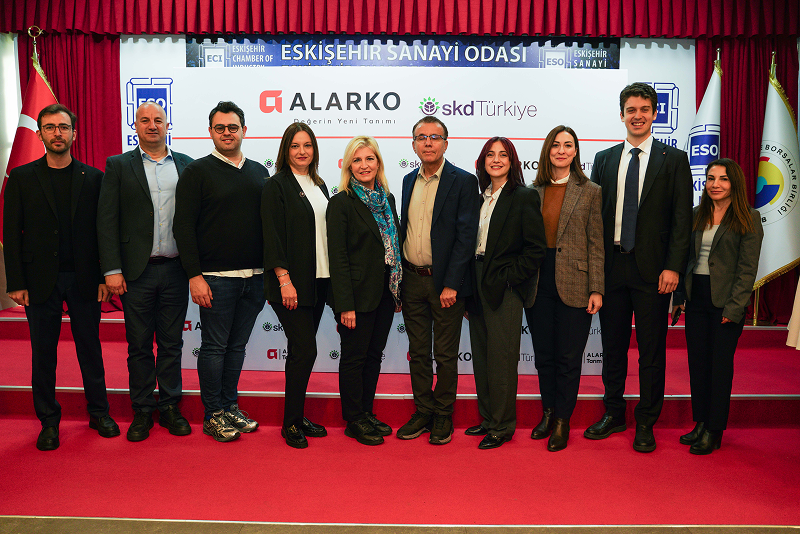
Within the scope of the program carried out by SKD Türkiye’s Sustainability in Agriculture Task Force, the first training was held with the support of Alarko Holding and the Alarko Agriculture Academy. On Wednesday, December 17, 2025, the training program organized at the Eskişehir Chamber of Industry addressed topics including Sustainable Agriculture, Modern Agricultural Technologies, the Future of Heirloom and Hybrid Seeds, Fertilizer Use in Agriculture, Good Agricultural Practices from the Sector, and Entrepreneurship and Business Development Processes. These topics were delivered from a multidimensional perspective by expert academics, industry representatives and civil society stakeholders. Featuring best-practice examples from various sector brands, the program brought together all agricultural stakeholders in the region, particularly women and young agricultural workers.
About the Business Council for Sustainable Development Türkiye (SKD Türkiye)
Founded in 2005 by 13 private sector representatives, the Business Council for Sustainable Development Türkiye (SKD Türkiye) is a business association that accepts corporate membership only. As the Turkish regional network and business partner of the World Business Council for Sustainable Development (WBCSD), SKD Türkiye shares the sustainability expertise derived from this collaboration with its members and stakeholders through working group activities and various platforms. Today, SKD Türkiye comprises 185 member companies across 45 sub-sectors in 14 main sectors, representing 25% of Türkiye’s GDP and providing employment to approximately 1.4 million people.
The full “Strengthening Women’s and Youth Employment in Agriculture” report can be accessed via the link below.
https://www.alarko.com.tr/media/uklg0lay/tar%C4%B1mda-kad%C4%B1n-ve-gen%C3%A7-istihdam%C4%B1n%C4%B1n-gue%C3%A7lenmesi-raporu_18122025.pdf
Latest News


New Graduates of Alarko’s “Positive Impact – Green Collar” Program Receive Their Certificates